
Calder Capital, LLC is a Grand Rapids, Michigan-based mergers and acquisitions advisory firm founded in 2013.
The firm operates nationally, handling transactions in the $1 million to $100 million enterprise value range, with a focus on manufacturing, distribution, construction, and business services companies.
Axial, a well-known deal sourcing platform for the lower middle market, has ranked Calder among the top M&A firms in its segment multiple times.
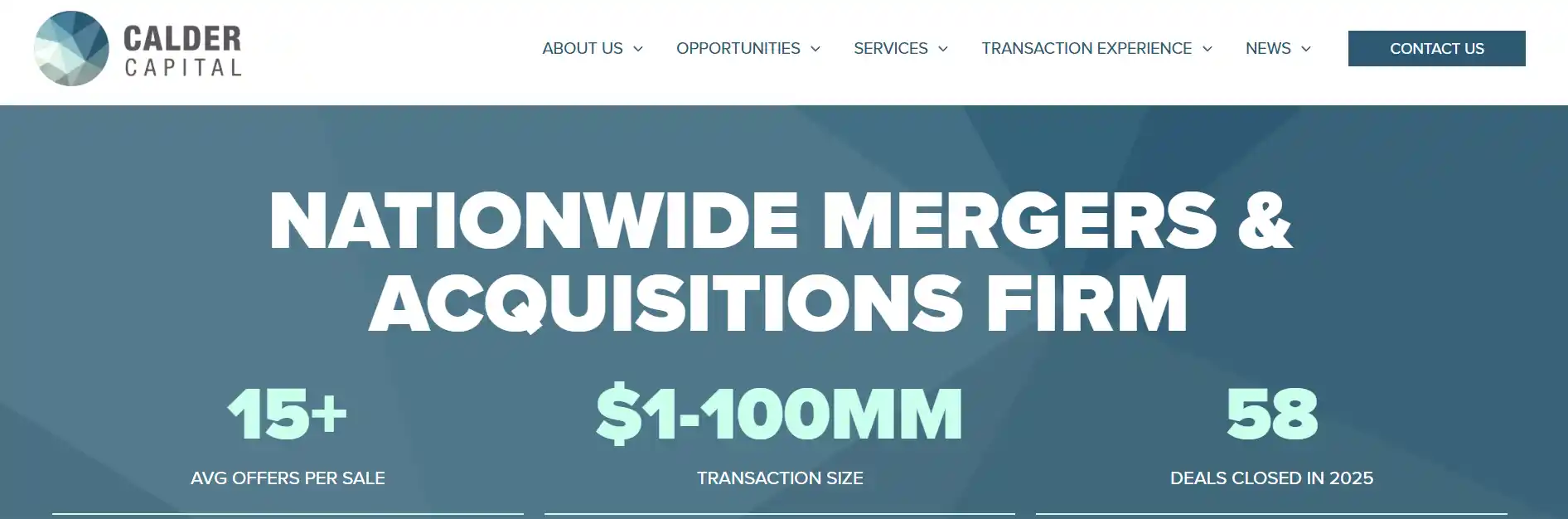
By 2025, the firm reported 58 closed deals for the year a number that reflects both its transaction volume and the scope of its national reach.
Key Takeaways
- Calder Capital averages 15+ competitive offers per sell-side engagement, frequently resulting in sale prices that exceed initial valuations.
- The firm's Buy-Side Gold program is the only one in the U.S. that guarantees 10 proprietary seller introductions or the client doesn't pay.
- A proprietary database of 350,000+ potential buyers, combined with automated multi-touch follow-up, powers a buyer outreach process most M&A firms can't replicate manually.
What Calder Capital Does
The firm splits its work across three main service lines: sell-side advisory, buy-side advisory, and business valuations. Sell-side work is where Calder has built most of its reputation.
When a business owner decides to sell, Calder runs a full marketing campaign not a quiet, relationship-based process. They go wide.
The proprietary database of over 350,000 potential buyers gets tapped, and outreach goes to financial buyers, strategic acquirers, and individual entrepreneurs across different industries and geographies.
The buy-side operation flips that model. Instead of marketing a business, Calder researches and contacts potential sellers on behalf of a buyer client. This involves cold calling and emailing business owners who have not listed their companies for sale what the industry calls off-market deal flow.
Their reported response rate of 40%+ from contacted owners is notably high for this type of outreach, and it's driven by consistent, structured follow-up rather than occasional check-ins.
How the Sell-Side Process Works
The funnel Calder describes on its website moves through four distinct phases:
| Stage | Activity | Volume |
|---|---|---|
| 1. Broad Buyer Marketing | Database outreach, targeted advertising, personalized contact | Tens of thousands of buyers contacted |
| 2. Buyer Qualification | NDA execution, Confidential Information Memorandum distribution | Hundreds of qualified buyers |
| 3. Indications of Interest | Initial offers received from serious parties | 10–30 IOIs |
| 4. Letters of Intent | Serious offers with deal terms | 5–10 LOIs |
The outcome at the bottom of that funnel one winning buyer with the highest price and best terms is what Calder pitches as the competitive advantage of running a broad process.
The argument is simple: more buyers competing means better terms for the seller. Their average of 15 competitive offers per engagement supports this claim, and the firm states that sale prices frequently come in 20% or more above initial valuation when competition is created this way.
The Buy-Side Programs
Calder offers three tiered buy-side service packages: Bronze, Silver, and Gold. The Gold program is the most aggressive and includes the firm's guarantee 10 introductions with sellers who match the buyer's criteria for industry, geography, and size, and who are willing to engage in a conversation about selling. If Calder doesn't hit that threshold, the client doesn't pay.
That's an unusual commitment in a space where most advisors charge retainers for effort rather than results.
The process behind the guarantee involves direct outreach to each targeted seller seven times within a two-week window. Before introducing any seller to a buyer client, Calder conducts a 30-minute interview with the seller to confirm fit.
Buyers who use this program reportedly pay an average of 0.5x EBITDA below fair market value on closed transactions a function of negotiating off-market with sellers who haven't yet gone through a full competitive sale process.
Industry Focus and Geographic Reach
Calder's transaction history spans over 30 states, and the firm handles deals from coast to coast.
That said, a significant portion of its closed transactions are concentrated in the Midwest Michigan, Indiana, Illinois, and Ohio show up repeatedly in the firm's tombstone gallery. The industries where Calder has the most documented deal experience include:
- Industrial and precision manufacturing (CNC machining, die cutting, tool and die)
- Wholesale distribution
- Construction and specialty contracting
- Service businesses (commercial cleaning, staffing, veterinary practices, car washes)
- Food and beverage production
- Digital marketing agencies
Transaction sizes skew toward the lower middle market. Most businesses Calder represents carry cash flows well below $5 million, though the firm does engage on larger deals with EBITDA above that threshold through its middle market practice.
What Clients Say
Calder's website publishes an unusually large library of client testimonials, covering both sellers and buyers across many transactions.
A few recurring themes show up across those accounts: responsiveness from individual advisors, transparency about where deals stood at each step, and a willingness to stay involved through the complicated late stages of a transaction.
Dennis Gadacz, the founder of Midstates Elevator Company in Mishawaka, Indiana, noted that Calder found the specific type of buyer he had described something he doubted was possible going in.
Steve Hansma, the former owner of Allied Electric in Walker, Michigan, credited Calder's advisor Garrett Monroe with navigating challenges that could have derailed the deal.
Linda Otis, who sold Double Otis, Inc. in Grand Rapids after the death of her co-owner husband, described how Calder coached her through buyer conversations before they happened and helped her assess which buyer genuinely fit the company's culture.
Cross-referencing those accounts against the buy-side experience, buyers consistently note that Calder represents its clients firmly without being difficult to work with a balance that matters when both sides of a deal need to get to closing.
Recognition and Credentials
The firm has appeared on the Inc. 5000 list of fastest-growing private companies in the U.S. It holds an accreditation from the Better Business Bureau and is a member of the Grand Rapids Chamber of Commerce.
On the deal sourcing side, Axial's platform has ranked Calder among the top 25 lower middle market M&A firms in the first half of 2025.
Calder also maintains a published M&A Code of Ethics on its website — an attempt to address the transparency gap that, in its own assessment, exists at many traditional advisory firms.
Conclusion
Calder Capital occupies a specific and well-defined niche: lower middle market M&A advisory for owners of manufacturing, distribution, construction, and service businesses who want a competitive, process-driven sale rather than a quiet handoff to a single buyer.
For buyers, the off-market sourcing model addresses one of the harder problems in small business acquisition finding deals before they go to auction.