
The Northern Trust Institute is the research and advisory arm of Northern Trust's Wealth Management division, a Chicago-based financial institution founded in 1889 that currently manages $1.6 trillion in assets and holds $16.8 trillion in assets under custody and administration.
Launched in June 2020, the Institute functions as a dedicated knowledge center, bringing together more than 175 internal experts to analyze client behavioral patterns, develop wealth strategies, and deliver personalized guidance to high-net-worth individuals and families.
The premise is straightforward: draw on 135 years of client outcomes and translate that into structured, actionable advice.
Key Takeaways
- The Northern Trust Institute pools over 175 specialists to create wealth advice grounded in real client data, not generic best practices.
- Content is organized around four client types: business owners, executives, multigenerational families, and women managing wealth.
- The Institute also serves professional advisors, giving financial planners access to the same research and strategy frameworks used with direct clients.
What the Institute Actually Does
The Institute's methodology follows a four-step cycle. First, the team analyzes behavioral patterns from past client outcomes to identify what strategies have worked.
Second, they develop advice frameworks using those findings. Third, the advice gets organized and delivered at the moments clients are most likely to need it, ahead of major financial decisions rather than after them.
Fourth, they collect client feedback to continuously refine the guidance.
This loop between data, strategy, delivery, and refinement gives the Institute a structure that functions more like an applied research center than a traditional advisory team.
What separates this from a standard wealth management offering is the explicit focus on behavioral analysis.
Rather than building advice from general financial theory alone, the Institute draws on patterns observed from thousands of client interactions across more than 30,000 fiduciary accounts managed by Northern Trust trustees.
The firm also manages over 27,000 family businesses, real estate assets, and specialty holdings like agricultural land and oil and gas interests, which means the research pool covers genuinely complex wealth situations.
Who the Institute Serves
The Institute organizes its content and services around four distinct client profiles:
| Client Profile | Focus Area |
|---|---|
| Business Owners | Wealth tied to a private business; planning for liquidity events, succession, and sale |
| Executives | Concentrated stock positions, equity compensation, and corporate transition planning |
| Multigenerational Families | Intergenerational wealth transfer, trust structures, family governance |
| Elevating Women | Wealth strategies tailored specifically to women navigating inheritance, divorce, or career transitions |
Each profile gets its own curated library of research, articles, and planning tools. A business owner facing a sale doesn't have to sort through generic estate planning content.
They land directly in a track built around that specific challenge. The same logic applies across each category. Professional advisors get their own dedicated section.
Planners can access tools like the Institute's modern trust provisions framework, which covers more than 30 individual trust and will provisions, along with content on topics like Delaware Trust advantages and how to handle illiquid assets in divorce proceedings.
The Research Output
The Institute publishes content across three main formats. The Weekly Five provides a short weekly market update connecting recent financial developments to portfolio implications.
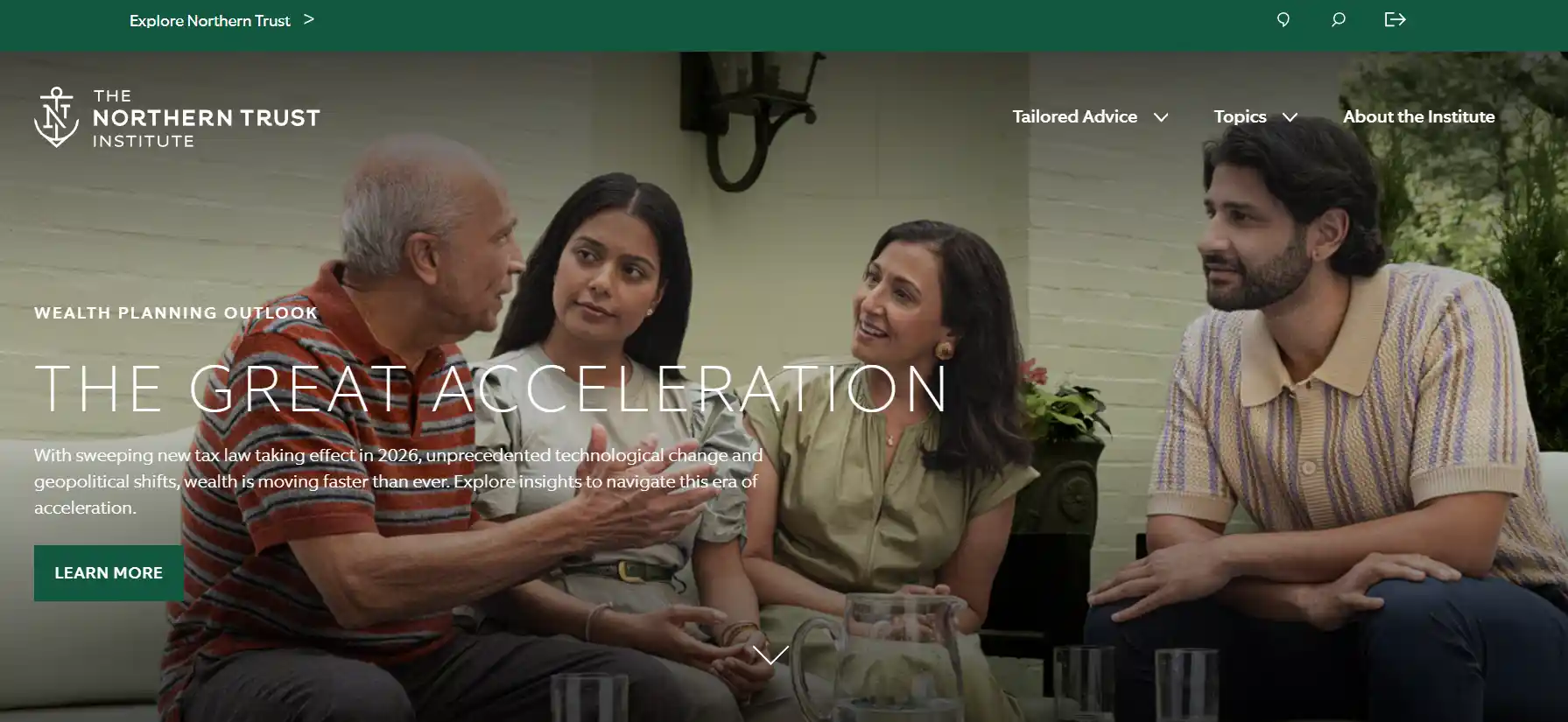
Trends & Strategies digs into specific planning scenarios, such as the new 2026 tax law changes, which the Institute has categorized under a theme it calls "The Great Acceleration.
The Money Masterclass series goes deeper on specific wealth planning concepts, with pieces on family governance, intergenerational wealth secrets, and the question of whether a family office structure makes sense for a given client.
The current flagship piece in 2025 and into 2026 is the Wealth Planning Outlook, framed around the convergence of new tax legislation, geopolitical shifts, and accelerating technological change.
That context matters for the Institute's target audience: families who may have benefited from the pre-2026 estate tax exemption environment now face real planning pressure to act before rules change.
Carl Tannenbaum, Northern Trust's Chief Economist, contributes macroeconomic context, including the firm's formal outlook and capital market assumptions.
The 2026 Capital Market Assumptions project that U.S. company revenues will grow at roughly 3.5% annually over the next decade, slightly below the prior decade's pace but still positive in absolute terms.
That kind of specific, numbers-grounded framing runs throughout the Institute's output.
The Leadership Structure
The Institute's leadership team carries significant depth across specialized disciplines:
- Eric Freedman serves as Chief Investment Officer for Wealth Management, overseeing investment strategy across client portfolios.
- Jane Ditelberg holds the role of Chief Tax Strategist, a position that has taken on added relevance given the 2026 tax law changes.
- Marguerite Griffin leads Philanthropic Advisory Services, covering charitable giving, donor-advised funds, and legacy planning.
- Amy Szostak directs Family Governance and Education, working with multigenerational families on the structural and relational side of wealth management.
- Steph Wagner leads the Women & Wealth practice, addressing financial planning challenges specific to women at major life transitions.
- Pam Lucina, who originally built the Institute, now heads Global Family Office Solutions after spearheading the Institute's creation as Chief Fiduciary Officer.
The faculty includes an additional bench of regional officers, senior fiduciaries, and investment professionals, bringing the total collaborating expert count to over 175.
Northern Trust also has 16 ACTEC (American College of Trust and Estate Counsel) members and more than 650 fiduciary professionals across the organization, which provides the Institute's research with a credible technical foundation.
Scale and Geographic Reach
Northern Trust's parent organization operates across 24 U.S. states, Washington D.C., and 22 international locations covering Canada, Europe, the Middle East, and the Asia-Pacific region.
The Institute's client-facing operations are primarily U.S.-focused, with services available across 20 states.
That domestic reach, combined with the broader corporate footprint, means the Institute can draw on global market intelligence while still providing locally relevant advice.
The firm also works with roughly 30% of the Forbes 400 wealthiest Americans, which shapes the caliber and complexity of the client situations informing the Institute's research.
What Works and What to Consider
The Institute's approach has a few clear strengths. The content is specific and tied to real decisions rather than abstract principles.
The four-stage methodology (analyze, develop, curate, refine) creates a continuous feedback structure rather than a static knowledge base.
The specialized client tracks mean that a multigenerational family and a corporate executive aren't receiving the same generic newsletter.
The firm's scale also gives the Institute something independent advisory firms can't easily replicate: a research foundation built on actual outcomes from tens of thousands of client accounts.
The 2025 Global Asset Owner Peer Study, which surveyed 180 institutional investors with portfolios ranging from $1 billion to over $500 billion, is one example of how Northern Trust generates proprietary data to inform its thinking.
The primary limitation worth noting is that the Institute functions within Northern Trust's broader business model, where advice and product distribution aren't fully separated.
Clients seeking purely independent research may want to use the Institute's content as one input among several rather than a standalone resource.
That said, the depth of the published material speaks for itself, and the credentialing behind the team is verifiable.
Conclusion
The Northern Trust Institute is one of the more substantive wealth research operations attached to a major financial institution, drawing on a real and large client base to produce guidance that goes beyond surface-level financial planning.
For high-net-worth individuals, business owners navigating liquidity events, and families managing complex multi-generational assets, it provides a well-organized and regularly updated resource that is worth consulting directly at northerntrust.com/united-states/institute.