
When selling, buying, or brokering a business in the United States, two platforms often come up: Axial and BizBuySell. Both connect buyers and sellers, but the similarities largely end there.
Axial is a curated, private deal network focused on the lower middle market, typically serving companies with revenues between $2.5M and $250M, while BizBuySell is the largest public marketplace where businesses of all sizes from small shops to multi-million-dollar firms are listed.
Choosing the wrong platform can cost time, money, and momentum, so understanding what each offers and where each falls short is critical.
Key Takeaways
- Axial is a private, vetted network for lower middle market M&A deals; BizBuySell is a public marketplace accessible to anyone.
- BizBuySell is significantly cheaper to list on, starting at $65.95/month, while Axial's fees can reach several thousand dollars monthly.
- Deal quality and buyer vetting differ sharply: Axial uses algorithm-based matching and screens members, BizBuySell relies on volume and buyer self-selection.
What Each Platform Actually Is
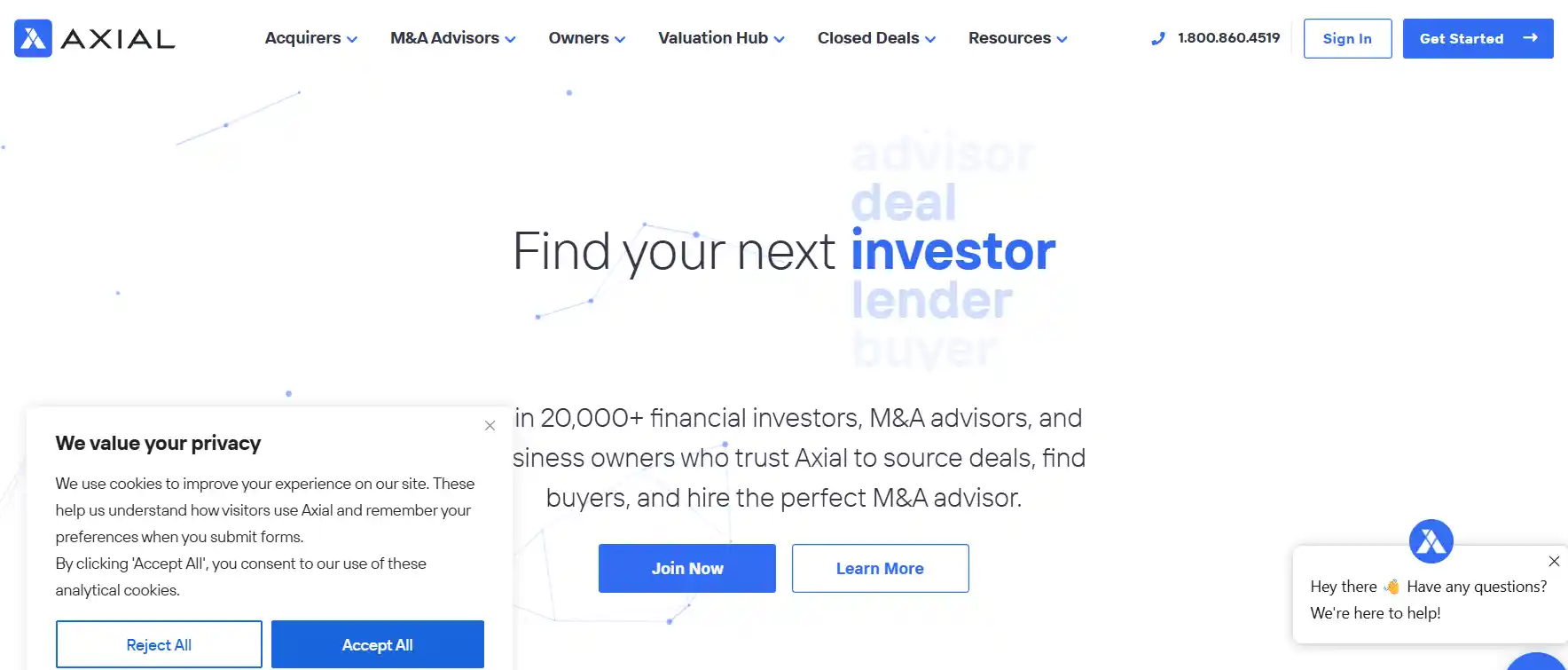
Axial launched in 2009 and describes itself as a private deal network. It serves business owners, M&A advisors, private equity firms, family offices, and corporate acquirers operating in the North American lower middle market.
The platform has over 20,000 members and sees more than 10,000 deals go to market every year. Critically, there are no public listings. The sell-side controls who sees their deal, and Axial's matching algorithm recommends the most relevant buy-side parties based on pre-specified criteria.
Think of it less like a job board and more like a proprietary deal sourcing tool with relationship infrastructure built around it.
Related: Transworld Business Advisors Review
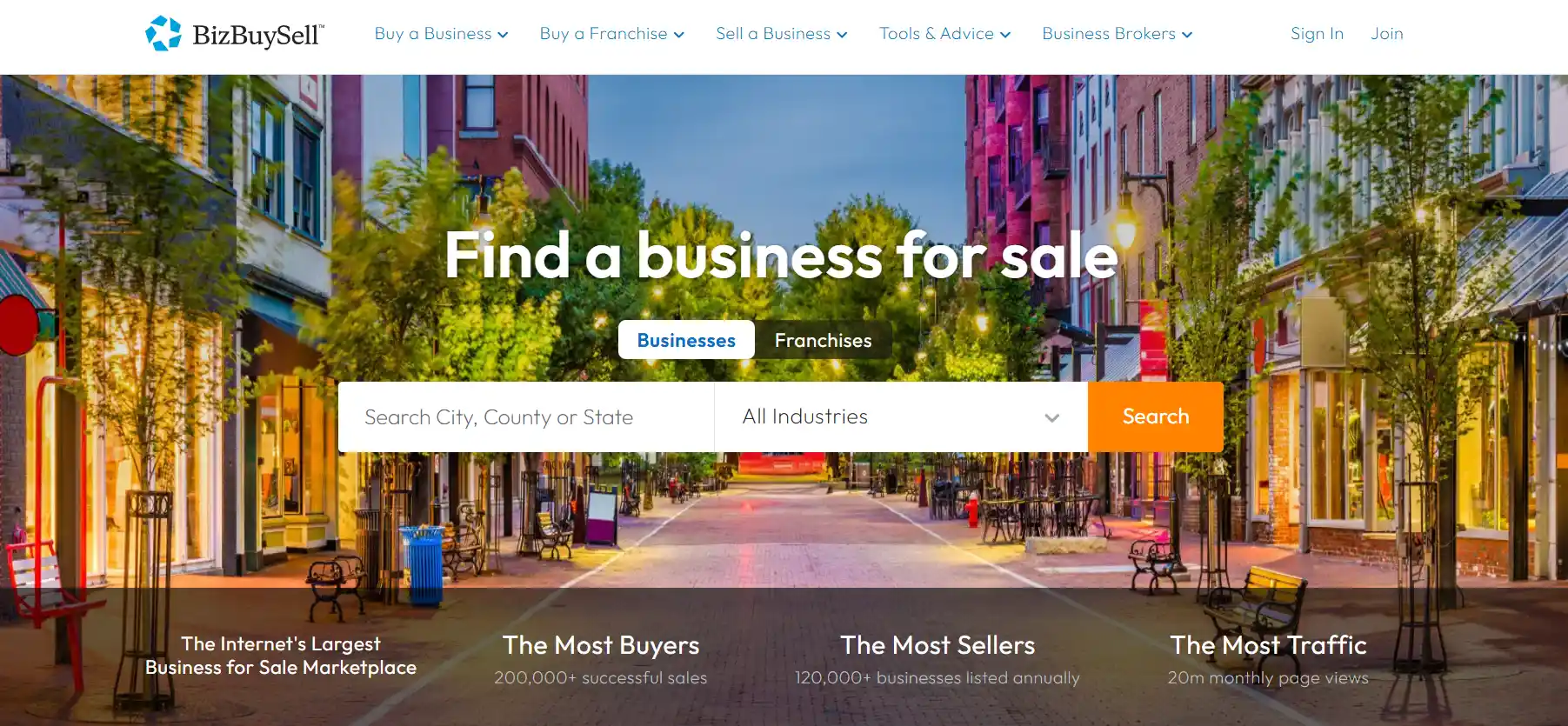
BizBuySell operates more like Craigslist for businesses, in the best possible sense of that comparison. Founded in 1996 and now owned by CoStar Group, it is the largest business-for-sale marketplace online by volume.
Listings are public and searchable. Any registered buyer can browse and inquire. Sellers or their brokers pay monthly listing fees to appear in the database.
BizBuySell primarily serves Main Street and lower-middle-market businesses, though the bulk of its inventory skews toward brick-and-mortar operations: restaurants, retail stores, service businesses, and franchises.
Related: Generational Group Review
Side-by-Side Comparison
| Feature | Axial | BizBuySell |
|---|---|---|
| Deal visibility | Private (invite-only distribution) | Public (searchable by anyone) |
| Target deal size | $2.5M–$250M revenue; $250K–$25M EBITDA | Main Street to lower middle market; no hard cap |
| Primary users | PE firms, family offices, M&A advisors, corporate acquirers | Individual buyers, brokers, small business owners |
| Listing cost (seller/advisor) | Not publicly disclosed; typically $2,000–$8,000+/month | Basic: $65.95/mo • Showcase: $89.95/mo • Diamond: $199.95/mo |
| Buyer screening | Vetted membership, algorithm-matched | Self-registered; minimal pre-vetting |
| Confidentiality controls | Full seller control over who receives deal details | Business name and location are masked until NDA |
| Transaction types | M&A, debt, minority equity, co-investments | Primarily full business sales |
| Deal volume (platform) | 10,000+ deals/year | Tens of thousands of active listings at any time |
| Valuation tools | DCF-based valuation calculator, LOI comparables, private market comps | Basic valuation tool; market-data-informed |
| Geography | US and Canada | Primarily US; some international listings |
Pricing: Transparent vs. Opaque
BizBuySell wins on transparency. You can see exactly what you're paying before you sign up. The three listing tiers for individual sellers are Basic ($65.95/month on a six-month term), Showcase ($89.95/month), and Diamond ($199.95/month).
Diamond includes priority search placement and BuyerBlast email distribution, and generates roughly five times more leads than a Basic listing according to the platform's own data.
Brokers can access a volume subscription service called BrokerWorks, which lets them list multiple businesses at discounted rates.
Axial does not publish pricing. Based on available market data and community discussions, platform access ranges from a few thousand dollars per month on the low end to $8,000 or more for higher tiers that include consulting and networking services.
A success-fee tier also exists for qualified buyers with private equity or investment banking backgrounds.
The cost difference between these two platforms is not trivial, and it largely reflects the difference in what you're buying: broad market exposure on BizBuySell versus curated, confidential deal distribution on Axial.
Related: What Multiple Does a Business Sell For? A Complete Breakdown by Industry
Who Actually Uses Each Platform
Axial's network includes over 4,500 financial investors and corporate acquirers, 3,500+ boutique M&A advisory firms, and a buy-side that ranges from brand-name PE firms to smaller family offices that don't appear in public directories.
If you're a business owner with $5M+ in revenue looking to run a quiet, controlled sale process, Axial gives your advisor the tools to selectively approach the right capital partners without broadcasting your intention to sell.
BizBuySell caters to a wider range of participants. Entrepreneurs searching for their first acquisition, serial buyers, small business brokers, franchisors, and individual owners who want to run the process themselves all use the platform.
One California brokerage, The Magnolia Firm, calculated a 3,837% ROI from the platform over 2.5 years, with 82% of LOIs in their last four transactions coming from BizBuySell buyers.
That figure speaks to BizBuySell's reach at the smaller end of the market.
Market Data and Deal Activity
BizBuySell publishes a quarterly Insight Report with transaction data, which is one of the more useful publicly available sources on small business M&A activity in the US. In Q3 2025, the report tracked 2,599 closed deals, up 8% year-over-year, with total deal value reaching $2.13B.
Median sale price eased to $320,044, and median time to close fell to 149 days, the fastest pace since 2017. Service sector transactions rose 11% year-over-year. Manufacturing showed weakness, with deal volume down 11% and median sale price off 37%.
These are Main Street figures, not middle market benchmarks, but they give sellers and buyers a real-time read on where the market is.
Axial focuses on the segment above that. Its annual M&A Fee Guide, published with Firmex and Divestopedia, tracks advisory fees and deal activity in the lower middle market.
The 2024-2025 edition found that only 30% of middle-market M&A advisory firms raised fees in 2024, down from 38% in 2023. Half of surveyed firms grew revenue. The average success fee ticked up slightly.
For deals in the $5M to $50M range, this is the most cited fee benchmarking data available.
Where Each Platform Falls Short
Axial's limitations:
- High cost relative to alternatives, which becomes a real issue when deals take longer than expected to close.
- Some buy-side users report overlap with BizBuySell and broker distribution lists, meaning you may pay Axial's fees for leads you could have gotten elsewhere.
- Less useful for Main Street deals under $2M in revenue; the platform is oriented around institutionally sophisticated buyers.
- Broker responsiveness varies, and competitive auction dynamics can push pricing in ways that disadvantage buyers who prefer bilateral negotiations.
BizBuySell's limitations:
- Minimal buyer vetting. Sellers regularly receive inquiries from unqualified or non-serious buyers, which adds friction to the process.
- Some users have flagged fraudulent or misleading listings, a risk that comes with any open marketplace.
- Valuation tools are basic and don't account for business-specific nuance well.
- Less suited for sellers who need confidentiality. Even with masked identities, the public nature of the platform creates exposure.
The Right Platform Depends on the Deal
For a $500K restaurant or a $1.5M HVAC company, BizBuySell is the logical starting point. The cost is low, the buyer pool is large, and the platform has decades of established trust in the broker community.
For a $20M industrial services company or a $50M healthcare business being run by an investment banker, Axial makes considerably more sense. The confidentiality controls, the buyer quality, and the matching infrastructure are built for that type of transaction.
Using BizBuySell for a deal of that size would expose sensitive information to an unvetted audience and likely undermine the process.
The two platforms are not direct competitors in most practical scenarios. They serve adjacent parts of the market, and experienced brokers often use both, leaning on BizBuySell for smaller or simpler transactions and Axial when deal size and buyer quality require a tighter, more controlled approach.
Conclusion
Axial and BizBuySell serve different problems at different price points, and the right choice usually becomes clear once you know the deal size and how much confidentiality matters.
If you're unsure which fits your situation, the deal size is probably the fastest filter: under $5M in asking price, start with BizBuySell; over $5M with institutional buyers involved, Axial is worth the cost.